Sunday, October 15, 2006

Copan Ruinas

Sipping a White Russian in my going-out jeans and tank top, looking around as friends and new acquaintances chat and flirt and request songs to be added to the itunes playlist, I feel closer to New York City than my Honduran hometown. I'm in an open air restaurant bought on the internet for $4,000 by a 23-year-old Californian only five weeks ago. He tells us, in between grabbing drinks for the customers who are, at this point in the evening, all teachers from private bilingual schools, that he majored in hotel and restaurant management, so really it'’s not as random as it sounds. Even as I admire the risk he's taking, I am gaping simply at the entire atmosphere of this place, Copan Ruinas, where I am out on a Friday night. That is, I am really out and not just on a trek down a dusty road to the pulperia that's open until nine to pick up some cornflakes or light bulbs for the back porch. I'’m put in the mind of summer evenings walking down Broadway in my tailored pants and Ann Taylor Loft sweaters, listening to Bloc Party on my way to meet friends for drinks at happy hours.

Ever since I arrived, but with a fevered intensity of late, I have been fantasizing about stumbling across a coffeeshop in my hometown here. Not to transport me back to my professional girl days, but just to evoke the peaceful happiness of those afternoon and evening coffees. "Oh!" I say in my dreams. "It's right here!"” And all the Hondurans I tell just smile and say, "“Of course it'’s right there."” So when faced with the prospect of going to a coffeeshop in Copan, I took a long time choosing, to draw out the pleasure.

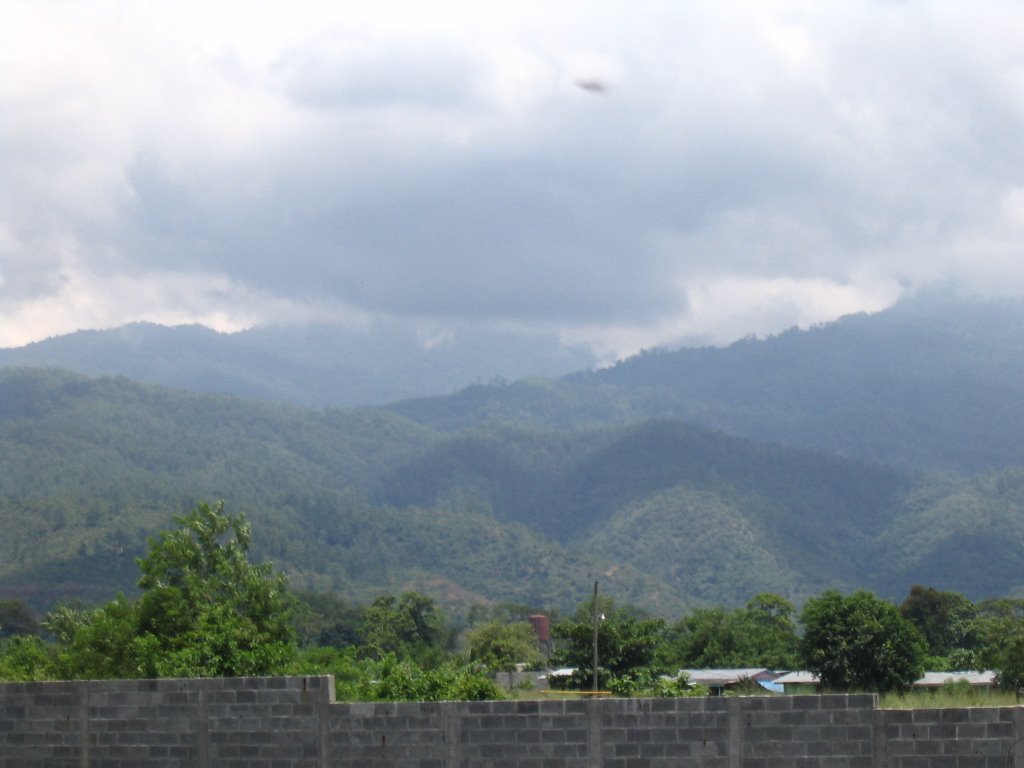
The one I chose has dark wood trim and tiles painted in a brick imitation that defies the classlessness implied in imitation--—it is innovative, the terra cotta bringing a tropical feel to a classic American style. The shop has three sides, the fourth has only a bar bench that marks the border of soothing order and the lush wild flourishing of the owners'’ front yard garden. The meadow grasses and flowers hide bits of the mountain view, a medley of small-scale color and greater green majesty. The mochaccino, served in a big ceramic mug, was sweet and soothing, as it should be. All was right with the world, and for a moment I could stop thinking about tourism, gringos, development, and the contrasts between life in Copan and in my hometown.

Visiting Copan makes me aware of how undeveloped my hometown would seem to a tourist, even though it is by no means rural or isolated. My hometown is just a regular place where showers are always cold, roads are always dusty, and uniformed schoolchildren swarm the streets. In Copan, there are restaurants that serve foods besides the platos tipicos and hostels with Israeli and Dutch backpackers. Souvenir shops and foreigners are ubiquitous, there are English book trade spots and shopowners quote me prices in American dollars. (I can't resist assuring them that I only have lempiras, that I live here now. I eat hamburger with real beef, albeit one only a centimeter thick and missing my tajadas (plantain chips) as I stare down the anemic french fries.

Everything's a bit mixed up in my mind in Copan. It'’s a disorienting place, with baleadas sencillas for 10 lemps and imported Gala apples from Chile for 12. I get confused about who I'm supposed to speak to in Spanish and who in English. A friend and I meet an Irish guy in the hostel while he'’s waiting to use the shower that is off our room and because he starts speaking to us in Spanish we keep speaking it, even when he says he'’s from Ireland. I mean, I knew we should start speaking in English at that point, but we were in a rhythm, even as he got increasingly weirded out. Another friend walks in and breaks the spell by saying, “Wait a minute, did you say you were from Ireland? Why are you guys speaking in Spanish?" We start laughing, but I'm mortified, particularly when he says, "Well, I don'’t like to presume that you speak English, but you said you were from the States and then kept responding in Spanish..."

I've started trying more often to make conversation in general, and particularly with the Hondurans I interact with--—the guys at the stand where I buy a coffee granita after school (a wonderful, wonderful find of last week), the woman who sells me a bag in a craft market in Copan. I tell people a lot what I do, but I'm much more interested in hearing how they spend their time, what their thoughts are. Some people--—like the women at the bus stop on the way to Copan--will barely let you get a word in once they start. (They aren't fans of the current president at all, because he doesn'’t do anything for the real people, the poor people, they say, and in our town no one has papers for the land, so the government says they could make everyone move and use the land, so everything under this new president really isn'’t going well, and by the way, it's dangerous for us four to be traveling without a man.)

To get to Copan, my friends and I board a bus that is not supposed to stop. (We called to ask them to look out for us at our boulevard.) Thus we can't really complain that there are no seats left. We brace ourselves against the coach bus seats, transplanted into an old American school bus, along with a sweet sound system, of course. More than an hour later, when some passengers disembark from the "direct"” bus, we gain seats. As I plop down, I notice a friend giving me a goofy look. I turn to my right. The woman next to me has two chickens in a cardboard box--—the first chickens I have seen on a bus, in fact, despite the American slang name for cut-rate Honduran buses. Not a big deal, except that she seems to keep inching the box closer and closer to me, and one chicken seems increasingly interested in stretching its head towards me. I scrunch up towards the aisle and manage to nod off, but am awakened by the chicken lightly pecking at my leg. The woman is giving the other one some water out of a plastic cup. I start staring the friendly chicken down, but he seems unintimidated. But somehow IÂ’m more comfortable with him than a previous trip, when a woman was nursing her baby next to me for most of the time and immediately behind me was a chatty man whose conversation starter was, "I lived in Texas." At that point, I did, in fact feel compelled, as surely you would, to ask where and why. "“Prison. Undocumented."” It'’s okay, though: he found God there. Whatever journey these chickens are making is probably pretty significant for their lives, but they don't want to talk about it, and since the road by that point is sickeningly windy, I can't say I mind.

On our second night in Copan, seeking fun, my friends and I headed to a bar further afield. We started talking to some guys in their late teens, and were startled when one responded to a question in perfect, American-accented English. "We were the first class at the Mayatan school," another guy explained. (I hope future students from our school, who will attend it for their entire elementary education careers, will speak so well someday.) Two of the three guys were dressed like New York hipsters. Like I said, very disorienting. All of the sudden, we found ourselves across the street from two men engaged in a brawl—with knives. Two other men jumped into the fray with their own knives as we ourselves jumped, behind our new Honduran friends. "“Don'’t worry, we'’ll protect you,"” they assured us in English as we ran to the bar, terrified. When we were in the clear, they told us that women are pretty safe in those situations, since they just never get involved in the fights, and besides, everyone in town looks out for the tourists.

"“We'’re fortunate,"” one long-time resident told us that same night. "“We have the tourism." Somehow--assumming some prototype of an ignorant American looking for the pristine exotic locale--—I expected the woman to talk about how all the foreigners have overrun her childhood home. But whereas in my adopted town, many people are self-employed or work in the maquilas, in Copan, teaching Spanish or otherwise catering to the tourists is the way to advance oneself. I was happy to speak with her; she is a woman I admire, a woman with a strong voice for her ideas. She suggested firmly as we spoke that our teacher team set a schedule for speaking Spanish at home, since we spend so much time together conversing in English. She even proposed a harsh punishment for the disobedient: doing the others'’ laundry. And of course we got teased for finding laundry so hard, protesting that we didn'’t cry the first time we did laundry at the pila: —those were beads of sweat!

The reason behind the tourism, the old Mayan city, is beautiful and peaceful--—surely not the way it presented when the buildings were whole and in use. That wonderful green lawn must have trampled by priests pouring liquid offerings into the altars, athletes pouring out of the locker rooms (yes, they did have rooms they used for changing, archaeologists believe) to play a ball game whose stakes were death, servants going on errands, carvers assembling crews for the king'’s latest commission. My friend and I didn'’t pay for a guide, so we listened in on several snippets of lecture in English and Spanish at various points during our wander around the grounds. We saw the longest Mayan hieroglyphic inscription in Latin America, featured on a huge stairway that archaeologists reassembled in largely random order. At first we were hesitant to climb on the ruins, but we soon got into it, even if we were saddened to see some teenaged girls checking out each others' makeup while perched on top of a temple. My friend and I took a couple shots of each other from a hilltop with an arm out, as if saying, "“All this is my kingdom!" Also, we spent a few solid minutes poking fun at the folks who were videotaping. A whole lot of action shots at the ruins of an ancient city, eh? The serene Sculpture Museum provided us with useful explanations, such as that "pop" meant "“mat,"” and showcased some of the originals that they have replaced outdoors with replicas. (Sadly, it'’s a bit hard to tell the difference.) It also presented a lifesize replica of a temple called the Rosalila, which was found whole underneath another temple. The design of the museum is supposed to replicate the experience of finding the temple: —visitors walk through a long, dark, tunnel and then come out into the light to find the bright orange-red building. Considering how peaceful our trip was, though, I'll speculate that more people come to Copan now because it is built up as a tourist town than for the ruins themselves. But I'’m sure those ruins--—stark stone and strange imagery--make an impact on those who take a break from buying cheap ruins replicas to go look.

We snuck out of Copan at daybreak, slipping past the backpackers in the other room, and the young restaurant owner, who says not finding more permanent lodging has been good for recruiting business. We packed up and woke up the vigilante at the hostel who camps out on the porch, got our lock deposit back, and boarded the 6 am bus back home. When we arrived at 10 am, exhausted and somewhat unsteady on our feet from the sickening speedy downhill spiraling our bus did in the mountains, we got right back to work: our first stop was the copy shop, to ask what time they planned to close today. The first exam period of the year starts tomorrow, and while being here is a vacation in some ways, for our students it is most definitely real life. And real life means work--for them, and for us.

I am, however, hosting a memoir-reading tea party on Wednesday to sweeten the deal.

Sunday, October 01, 2006

'I didn't want to eat. I only wanted to spend time with the horse.'

And now you’ll want to hear about my students, and how they behave, and how well they speak English, and what they do that is endearing, and what they do that is insufferable, and how they have grown in the month since school began.

And I hold out my hands, browning daily in the sunny schoolyard, and wiggle my fingers—a magic trick. I conjure up a vision of them: sitting, standing, slouching over their desks. But the vision is not whole. It is a holograph to be looked at from one angle and then another, a computer screen that flickers when filmed.

“I forgot my homework,” F. tells me.
“You forgot it? That’s too bad. You’ll have to stay in for recess.”
F. grabs a page in her notebook and rips, then motions with it in my direction.
“No, miss.... She smiles.
A few minutes later she does the same act with presentation she is scheduled to give. Amazingly enough, I fall for it again.

The school director walks into my classroom to get a student to discuss a discipline issue. “Están tomando un examen?” It is a beautiful moment. They are in fact working on their second drafts of their memoirs. They were resistant to the idea of continuing to work on them, but working they are. A few have even added details based on an exercise—which they only partially processed—on different ways to begin a story. Alas the two students who have the most trouble settling down to work will be pulled out of class. (They were calling a classmate names, and that classmate is a bit of a tattletale.) I instantly blame myself for not better handling behavior management and discipline. I wonder what those two students might have written if they had stayed in class. The beautiful moment is broken.

But the students have written some heartfelt pieces, intimate, full of lines that are telling and lines that are inadvertently poignant:

When I went to school, I did not want to go play at lunch. My teacher called my parents to ask them what was wrong. I was traumatized. ..... Three years later my father left the alcohol.

I didn’t want to eat. I only wanted to spend time with the horse.

My grandfather’s nickname was Papiman. He would always give me five lempiras to buy candy.

I ask a student in class one day whether she is sick—her eyes are red, her face looks a little puffy. She says she is fine with a flat, strained voice that sounds like the indifferent tone she always uses. But the next day I see her crying during lunch. How could I not have realized she was upset? It has something to do with a boy, I think. I don’t know what to say. Her other teacher gives her permission to skip the next class. I awkwardly give her a pat on the back and say, “Hope you feel better.” I doubt she is comforted.

Another day. The boys in my class ask me, “What did you do to your hair?” They want to know why I cut it, where I cut it, and why does one side look shorter than the other? When I lean over their desks to ask them questions about their work they reach up to touch it. I remind them of our class “no touching” rule. I tell one student that I don’t touch his hair, either. Of course, he offers that I could if I wanted to. Walked into that one.

A girl observes that another girl is very flexible. “She is a snake.” I ask why. “She drew a picture of a pig with my name on it. She is a snake." She doesn’t seem shaken by the interaction, and I am so proud of her chain of thought. I consider that perhaps I should not ask students to describe each other when we continue our work on metaphors.

The students whine a lot. They complain a lot. They say “Ayyy Misssss!” They try to convince me that I said the vocabulary quiz would be on Tuesday, that they didn’t know, that they had too much work and it’s very unfair and they did not have time to study, and didn’t you say it was Tuesday—you did, you did! I find it very hard not to get visibly angry. These kids are very lucky to be going to school, but like kids everywhere they don’t appreciate it much. It’s comforting, somehow, to know that kids everywhere are so similar. They call school a jail (“But jail is better because you have TV and you can relax,” one student told me), want only to talk to their friends, spend too little time on their homework, and need to borrow pencils. It can be hard to keep that in focus after a trip to City Mall, where the clothes are American style with American prices and all the classic fast food chains are there. (Watching an undubbed Lindsey Lohan movie in the air-conditioned City Mall movie theater made me ridiculously homesick.) But always I am reminded of how their experience of normal is different in the details. One student’s father works in the States, illegally. He has been gone three years, and he’s supposed to return, but...

There are so many stories that I want to discover, and I hope my students will let me into their lives in the same way that I’m trying to let them into mine. They are fascinated to hear about my life in New York, my family, my friends and their extraordinary world adventures. They love to ask questions about topics I know about off the top of my head that are new to them, like Judaism. If you want to expand their interest, mail me some matzoh—they would love to try it.

My students--seventh, eighth and ninth graders--at times seem a bit anomalous in the context of the whole school. To have stuck it out this long, past the government-mandated sixth grade education, they generally have parents who are very involved in the school. There are fewer scholarship students, and on the whole their families are really committed to helping secure a strong future for them. For that reason, I sometimes feel that I am not getting the chance to grasp first-hand the wide variety of our school attendees’ experiences. I also feel detached from the school community on occasion because the junior high is in its own building and my classes are smaller, so I know fewer kids. But then I walk to school and get passed by a busito, the students scream “Miss!” and stick their arms out the windows to wave. Then a first-grader being taken to school on a bicycle yells “Good morning!” at me from quite a distance and repeats the phrase until I snap out of my daze and yell back. Then a group of students sings The Wheels on the Bus to me at recess. I realize I am a part of it all. I just have to keep pulling myself into the mix.

**********

I decided after racing through the book Banker to the Poor that in the future I want to manage something big and ambitious and innovative. I like to manage, even if it’s just the creation of a house stir-fry meal. I remind myself that I’m scaling up, to adopt business-speak. Putting out the paper five days a week was a warm-up for placing knowledge in twenty adolescent minds five days a week. I foresee even greater and similarly serendipitously wonderful challenges ahead. Maybe in that vague “ahead” place, I’ll even be able to escape the painfully earnest tenor of this paragraph.

Monday, September 18, 2006

Taking refuge in cool Cusuco

The mountains in Cusuco are so beautiful. In the dusk they are beautiful and dark in the ever-darkening sky and no camera can capture them. I have never seen so many stars before—not even that time in Maine when I couldn’t see my own hand in front of my face. I can’t count those stars, could never count them, and the big aloneness of it or the old friends in my mind or the cold breeze on my bare feet make tears roll around my eyes. The stars stay up there, blinking and blurring, but the tears will not fall out.

The town lies below, like in storybooks, but not with poetic pinpricks of light: the blobs of orange light are streetlights that supervise the cars I can’t see swerving around dusty deep potholes and expose the green in the puddles I can’t see where frogs ping like a fast-paced video game. I feel homesick for this place that is not mine, knowing the cars and frogs are there. It has made itself present to me through a real expression of its essential self. Human-made, it declares, shining into the mountains covered in types of ferns that dinosaurs once ate.

The coffee we drink in Cusuco is straight from the palo, rich and warm. In the morning I dip in pieces of my puffy fried tortillas, already sugary-sweet with naranja marmelada that the cooking women have made in their homes. How, I ask them. I think, How and who and what and when and why. The jelly, I clarify. Yes, the delicious jelly. How do you make the jelly, and how do you live this life—this life that is yours and mine and not ever ours. They tell me how. They pick the fruit near their homes and boil it, they say, they add the sugar and the pectin, they say, they put it in jars when it is gelatinous and hot hot, they say, really hot. They tell me that tomatoes are out of season already, planted in January and harvested in June or July. For the tortillas, they make three slits in each—look, like this, así—to make them expand with the heat of the stove. Two of the sons of the cooking women sit on a bench, whispering to each other. One boy tells me he likes mathematics best in school. That detail seems more important than the two teachers in the school, than the hundred students in the school. Scrawny chicks huddle together under a small overhang to get out of the rain and they are more important than me getting soaked. The woman at the top of a mountain nearby has story lines in her face. But I just coo at the plants that she sells. I just offer her a leftover piece of breakfast tortilla and ask, How many years have you lived here? Forty, she says. The number weighs her down, makes her sink into a pace in my mind where she will not flit away.

In the forest our guide feeds us tart citrus fruit, guayaba, or guava, and pieces of an acidic stem that supposedly alleviates thirst. There are too many plants and too many plant names. One tree grows flowers that are an official plant of El Salvador—and that Hondurans eat fried with nationalistic glee. There are three kinds of ferns. Some vines are like wood and good for swinging. Some vines that look the same are like plants and will break under your weight. Cola de mono looks like a monkey’s hairy tail, curled towards the sun, oreja del burro is a split-open seed-pod that falls to the ground. Labios de mujer look lascivious, painted a too-bright purple. We hike to a waterfall and lie on rocks near the cold spray.

One day we get a ride down to our lodge with a family from the city who escaped for the weekend to camp in the coolness of the mountains. They talk about colonias in New Jersey they have visited and I am startled to realize a colonia is not something exclusive to here—it’s just a word. The truck’s CD player shows reggaeton music videos. The contrast between it and the truck we take to school sometimes was as great as the climate difference between the mountains and our town in its heat-trapping valley.

After a tranquil weekend, the ride home is violent—an appropriately driving rain bombards us as we squat in the back of a pickup truck. Water puddles in our clothes and stings our faces. We slide backward and forward as the truck strains to climb inclines and swung around steep downhill curves. My arms get sore from bracing myself on the side of the truck. But as we descend, the air gets thicker and warmer and the rain slows to a drizzle. Our clothes begin to dry and we lose the subdued, survivalist look of endurance. As we drive back into the colonias surrounding the center of town, we began to sing—Disney’s greatest hits. We swing our dripping, sleeve-sheathed arms to wave adios to gawking families. On foot we might have been embarrassed, but soaking, exhausted from hiking, and anxious to be home, we are glad to be united, singing, back in the gringo spotlight.

Saturday, September 09, 2006

School becomes laundromat

On a break from band practice, A. drums her way around the school office, maneuvering around a cactus-like plant and ducking nonchalantly under a row of underwear, hanging from a clothesline attached to the office and the flagpole. A friend and I had hung our underwear there to try to keep it out of sight. We had suspended the rest of our clothes among the playground equipment, my towel drying snug up against the swing set, my shirts adding some color to a glance at the school’s gray block walls.

M. approaches as I throw more shirts and skirts into a big blue bucket and sprinkle in some laundry detergent, then grab another item to scrub and rinse it on the board next to the pila. “Laundry, teacher?” he asks with a smile. Even here, the sight of a teacher doing her laundry at school on a Saturday is worth a grin. I’m embarrassed, so I shrug modestly—“Still no water in town, so it's better to do the laundry here.” Usually the water only goes out for seven or eight hours at a time, but the water has been out since Thursday morning. M. shrugs back, since he lives in town, too, and then runs off to get back to practice.

The Independence Day parade is only six days away, and the band still sounds a bit garbled. For bands here, the instruments are primarily drums and xylophones, and dancing while playing is an important element. The twenty or so band members do a nice job with some tunes I don’t know, as well as the Honduran National Anthem and an excellent rendition of Simon & Garfunkel’s “The Sounds of Silence.” Last night when we were hanging out in the dark, without power, we heard the sounds of a band, so we walked out to the town square and discovered a parade for Children’s Day organized by some public schools. Dozens of children marched with blue, red, or green lanterns containing candles, and several bands much larger than ours performed, stopping at the entrance to the square to do an endless series of dances and beats involving turns, spinning of sticks, bobbing in all directions, head-turns, and swinging of xylophones.

Last weekend, we saw another sort of performance: a soccer game! Really not exciting enough to merit an exclamation point, since the score was cero cero. Made me understand why soccer games can become violent. There were guards with machine guns all around the edge of the field, staring at the crowd for the entire game, but the only crazy event was that some fans used the squares of paper handed out for confetti to start a small fire. We cheered for Olímpia even though Real Espana is technically our team because the Hondurans we were with object to the name Real Espana. One explained matter-of-factly, in Spanish: “The Spaniards killed our ancestors.” The trip home was way more exciting than the game. After squeezing onto the super-crowded bus and finding a seat between two guys who revealed they had some space available—“They want your body,” my already seated friend said, “but that’s okay,” I got to enjoy some fun conversation. “It’s really dangerous for you to be out late at night.” In response, I observed politely that it looked like it was going to rain and within a few minutes, lightening began to flash menacingly in the sky, rain came pounding down, the bus tilted frighteningly as we drove on the sidewalk to avoid puddles, and the lights flickered. At least we weren’t getting a ride home in the back of somebody’s pickup truck, as we so often do around town! But we made it home safely and capped off the experience with a mad dash home from the main street through mud and puddles and huge streams of water cascading down the abrupt drop-off that is our street.

You may have difficulty understanding my life this week here if you have done any of the following: taken a warm shower, turned on the AC, flushed a toilet and thrown your toilet paper in with it, washed your dishes with water from the tap, enjoyed an entire day of uninterrupted electricity. But you can approximate the experience a bit by making a lime licuado. Buy some limes, throw them in a blender with some sugar (okay, a lot of sugar), milk, water. Strain. Add some ice and blend again. Then pour into a tall glass and enjoy. I promise that it’s gonna be slammin’.

Friday, September 01, 2006

Striving for tranquilo

A bunch of platanos hangs from our rafters on the back porch and several white and light-blue birds have come by thinking to themselves, "“Sweet! A birdfeeder!"” It'’s very cute, actually. Less cute are the many types of ants who reside in our house. We have one kind of ant, a rather large, light-brown ant in the bathroom, and both large and small black ants in the kitchen. I had heard that ants bite, but I had never experienced the fury of tiny, tiny black ants--—well, of any ants, actually--until recently, when I was brutally attacked while attempting to cook pancakes. They sure do sting! Cleaning the kitchen became a serious priority immediately afterwards. Unfortunately, it is impractical to sweep and mop every single time anyone eats anything. Due to the lack of snack foods in Honduras, we have become huge fans of popcorn. In other animal news, last night we definitely spotted a tarantula on the back wall of our yard. It seems to have disappeared today, so I am hoping it went to visit the neighbors.

It has been a super busy week. After the teacher'’s meeting today, conducted in Spanish, of course, I felt saturated in Spanish enough to think to myself, "“It has been a week super-busy."” (I'’d like to take this moment to praise the director of the school, who speaks slowly and clearly enough that I actually understand her very well.) My favorite thing that I have picked up on is using bien as an adverb, as in "Es bien fri­o" or even "“Es bien malo"! Right now es bien caliente--this afternoon a mini-thermometer for science experiments showed 98 degrees. At 7 pm, with the sun set, it has dropped to 92 degrees.

I just realized that I have not mentioned on the blog that we had a full roster of fun events last weekend, namely a birthday party last Friday and karaoke--—which was hysterical--—on Saturday night, plus a huge feast for H's birthday on Sunday night. I led the creation of the stir-fry, and it was awesome, if I do say so myself. Most interestingly, though, when I went to church on Sunday morning, I found the church overflowing with people as a result of the thirty-one weddings taking place. There were kids eating flavored ices, adults fanning themselves madly, and couple after couple approaching the bishop to accept the vows. On the altar there was one up, and one on deck.

On Sunday night, after a full but fun weekend, I realized that I really had not planned properly for the week. Several nights this week I stayed up until 12:30 or 1:30 am getting ready, and then woke up at 5:50 in the morning. It was very painful. But settling into the new classrooms was great--—it's so nice to have my own space. When I looked at the room this afternoon before I left, I realized just how crazy it is that I'’m here with my very own classroom to set up and decorate and maintain. I have hung some posters on the walls with a rubber cement glue called UHU, and I need to hang up more. It just feels like such a commitment, because things pasted with UHU are not easily separated from the wall again. I have a line with clothespins attached to the window bars (I may have delusionally said previously there are screens, but in fact there are not) and I hang some papers there, but we get quite the breeze in our tiny Junior High pasillo, so they don'’t survive too well there. My co-Junior High teacher has crafted a nifty bulletin board out of cardboard and I really should do the same. I have been hanging up some inspirational quotes, in addition to the National Geographic maps. I made the ninth graders write last night about an Albert Einstein quote: "“In the middle of difficulty lies opportunity."” I'm looking forward to seeing what they have come up when I get around to grading their homework--really soon, I resolve in this very moment.

It was a pretty good week with the kids. I'’m setting up some new routines: a "Take One/Leave One" folder at the door for depositing homework and picking up handouts, space on the shelf for journals and for folders for in-class projects, vocab tests and independent reading time on Fridays. I find grading to be one of the more painful parts of being a teacher because I feel responsible when, for example, someone doesn't understand the assignment. But if other folks did, or asked questions until they did, then I think I have to subtract points.... I'’ve been thinking a lot about what it would be like to be in school and not be that great of a student. Those are the students whose minds I really need to get inside, so I can figure out how to help them.

Today was a half day for a teacher meeting, and next Friday is the Dia de Los Ninos, so the kids come to school for only three hours and play games we make for them. The week after we have another half day and a day off for the Di­a de Independencia parade. Hondurans are all about their celebrations. Makes it a bit hard to get in a school routine, though. I can get really frustrated here at times, because it is so hot, and I always feel so dirty (so much dust!), and life here is simply exhausting. Fortunately my sufferings have been alleviated somewhat because I have fallen in love with liquados, a true substitute for Starbucks drinks. Sipping a banana liquado puts me in the same mood as when I drink a chai creme--a mood I now have a word for: tranquilo.

Saturday, August 26, 2006

"I think I...conocer...?"

When we walk to school at 6:30 am, the dusty, uneven road to the town center is quiet. There are no trucks swerving right and left to avoid the rises and plummets of the rolling cobblestone-and-dirt street, but a few red and white mototaxis with three wheels race passengers to their destinations. Small groups of subdued, sleepy schoolchildren in uniforms—white shirts and blue skirts, green pants with light green shirts, gym t-shirts and warm-up pants—wait for the bus or walk to school. The walk is long—twenty minutes, at least—but the air is cooler so early in the morning. Sometimes we get a ride in the back of a pickup truck, speeding along at an exciting clip, except where we must pass over the muertos (dead people—a slang name for speedbumps) near a giant cigar factory. I hear that the cigars are imported to America, and that you can’t buy them here anywhere.

At the school, the watchman lets us inside the wall surrounding the school grounds. During the night, the watchman is a big old man with missing teeth, a cowboy hat, and a gun. The dayshift man, however, looks considerably less like a cartoon. The school buildings are made of cinderblocks, with bars and screens in the windows and big metal doors leading to each classroom. The pasillo, or hallway, opens into the school yard on both sides. The tin roof flexes in the heat, making a sound as if a sporadic hailstorm where constantly passing through the area.

The Junior High classrooms, in a separate two-room building on the grounds, were not ready at the start of school, so my students have taken up temporary residence in the library and an empty classroom that will be the teacher’s lounge. It has been a frustrating experience, particularly since every teacher’s book I have read emphasizes the importance of the start of the year as setting the tone. I am finding it difficult to make the students feel welcome and establish a routine when I cannot decorate or arrange books and materials. (Yes, the tone I myself adapt for this narration is considerably calmer than the one I used the night before school started when I learned about the delay.) The classrooms are supposed to have electricity by Monday. I’m hopeful, but not convinced.

The students, for the most part, are well behaved. The ninth grade boys are constantly whining, “Missss, he’s touching me!” They also, however, tend to participate more in class. The ninth grade girls are on the whole quieter and more serious. Their first journal entries ranged from the boring but true (too-cool-for-school girl writes [paraphrased from memory]: “I like music. My favorite music is salsa, meringue, reggaeton...”) to the endearing (cool guy writes: “I want to learn more about you and Miss ____) to the fascinating (bookish, hard-home-life kid writes of a pen pal friendship: “I know she loves me but it is very hard for us because of distance.”) In the combined seventh-eighth grade, there are only six chatty but adorable girls. They are much further behind in English. Their speech sounds like, “I think I....conocer...?”) Their wishes, according to their writing, range from wanting to visit the Bay Islands to becoming a doctor to being the best student in the class to traveling the world, to traveling the world as a model flight attendant. The last one might mean the best flight attendant, but I bet the intention was two professions rolled into one.

I’m learning a little more Spanish—some words here and there, like ganchas (clothespins)—and speaking it more than I ever, ever did in the US. I can more often follow a conversation than participate in it. As of yet, I am an extremely uninteresting conversationalist.

One major gripe I have with Honduras is that the constant sweating is wreaking havoc on my skin. The sunscreen and bug spray don’t help, either. I was born for a temperate climate! I have begun liberal use of baby powder, and I have begun dreaming of having a shower at school for when I arrive in the mornings. Ideally I would take about three showers a day, but I would never be able to wash all the clothes I would constantly be changing into. (Have I mentioned that laundry without a machine is a huge hassle?) Plus our water goes out very frequently. We have water most consistently in the afternoons, because the storms come in the evenings and then the water usually stays shut off until sometime the next morning. Nothing like waking up in the morning to realize that everybody is going to have to bucket flush the toilet before going to school.

Tonight we’re going to karaoke at the house of some prominent (read: wealthy) folks. I’m hoping there will be food—it’s so much easier when we don’t have to cook for ourselves. The most common foods served are: papusas, a ball of quesillo (a kind of cheese) enveloped in tortilla dough, and balleadas, made of thin flour tortillas folded in half, with refried beans inside and also a thin cream squiggled out of a bag, like frosting. There are also catrachas, a fried tortilla topped with refried beans, hard cheese, and sometimes (maybe with another name) diced cabbage and carrots. Once at school we were served hot dog rolls and cream, mantequilla, as a snack. (Shudder.) When we were in Triunfo at the beach last weekend, I had some toast and refried beans as a snack and it tasted awesome. I suddenly had the thought that I’ve been missing out on a wonderful thing all of these years. Good thing I came to Honduras, huh?

Monday, August 21, 2006

Beach time


The first picture is from the beach at Tela, where we stayed Saturday night in a really nice hotel: right on the water, iced pineapple juice delivered to the room upon arrival, and wonderous air conditioning. The other two pictures are the beach and the door to our cabana in Triunfo. It's much more rustic there, but the water was beautifully blue. The Carribean ocean is a wonderful thing to anybody raised in the Northeast. No offense to the Jersey shore, but this was the most gorgeous beach I've ever visited, and I could have stayed in the water for several days straight.

Thursday, August 17, 2006

The big city

The letters C O CA – C O L A are nestled in the hills above San Pedro Sula and outside a pizza restaurant stands an armed guard. Walking the grid of calles and avenidas, I inhale the copious exhaust of cars that honk in warning as they pass through each intersection. One store offers an “explosión de precios bajos,” another sells Converse sneakers. Water trucks and white taxis are everywhere. Moneychangers near the plaza flash their bills and say dollares, dollares.

The postcards for sale in the Mercado Guamilto depict the cathedral in the Parque Central and a few other older-looking buildings, but more exemplary is the corner marked by Wendy’s, KFC, and Burger King. When I waited for the Rapidito bus to the city earlier in the day, passersby greeted me on the street with adiós, and an old woman even grabbed my arm to tell me Buenas. But in San Pedro, all is economic: ¿Que quiere?

On the ride home we drive past a building with a huge picture of Tweety bird. A couple near the roadside cuts grass in their front lawn with machetes. I nearly fall asleep on the way home—I’m a small-town girl now, and the big city life wears me out.

Saturday, August 12, 2006

Dancing real close...

On Thursday I went out dancing, Honduras style. By which I mean I danced at somebody’s house, without the aid of alcohol, in a way I would not ordinarily dance in front of my parents, in front of other people’s parents. Oh, and with some of my students. But hey, it was pretty fun. A bonus is that it doesn’t require much in the way of conversation.

The guys, even ones who are twelve or thirteen years old, have no qualms about partnering up with you to dance to reggaeton. Alas it’s part of the same machismo that makes it so annoying to walk down the street with other girls. All the kids seem to dance with their friends and relatives all the time—and their parents encourage them. The guys don’t hesitate to pull you in real close for a dance step I like to call “make a small circle and sweat on your partner.” But it was fun to dance with folks who so obviously enjoy it, and who more or less excel at it. (No white man’s overbite here.) At a bar or club it likely would have been stressful for me, but it was such a friendly atmosphere that I left smiling.

I’ve learned how to go buy food at the local pulpeteria and the owner is extremely understanding of us gringas, which I truly appreciate. Por ejemplo, she showed us a pound of beans. (I would quote her, but I recall that she used some verb besides mostrar that I can’t quite recall.) I definitely need to review the Spanish words for vegetables. Today, however, we walked up the main street a ways to the supermarket. There are no street signs, so precision in directions can be difficult. The supermarket is the only place here that you can buy leche descremada and whole wheat bread. Unfortunately, leche descremada only comes in a box, as opposed to fresh in a plastic bag. Also unfortunately, boxed milk tastes—and smells—exactly as if it has been in a box for three months. Best to consider it some other sort of beverage altogether.

Vaya pues (“anyhow,” more or less), even after only a week here, trips to the supermarket in town are a special treat. Instead of asking for everything, I can look at what is available for myself and choose. Today another volunteer and I spent about twenty minutes browsing there, much to the amusement of the Hondurans, who do not seem to do quite as much recreational shopping. The supermarket has a pretty extensive selection, including shampoo in a big glass counter. A few days ago, I picked out a shampoo bottled that looked nice, but the employee helping me shook her head and pointed to the picture of a curly-haired girl. She substituted a more suitably straight-haired girl. (Even though in the humidity my hair is curlier than ever.) Today while using my “SEDAL Control Humect,” I figured out that it is “para la caspa.” That is, it’s a dandruff shampoo. Makes me wonder what I have been agreeing to in all those conversations when I respond with only a nod of the head and a little laugh.

Thursday, August 10, 2006

"Nos vemos!"

Life I love you
All is groovy

Listening to music (Simon & Garfunkel, if you hadn't guessed) while sitting on my bed in my room here transports me back to my bedroom in my old apartment. I can imagine that perhaps I have moved to another apartment—someplace a little shabbier, in the East Village, perhaps, where the super has forgotten to repaint the apartment.

But then my gaze flickers over the shelves made of rough planks and cinder blocks. In the heat I feel the blowing of the gale-force fan. (“There really isn’t a low setting: more like 100%, 95% and 90%.”) A rooster crows—they seem to have no sense of day or night. Often they sound not like roosters but like people demonstrating the noise they think roosters should make. A lizard climbs the wall. It is a gecko, I’m told, although despite watching the Geico commercials, I can’t be sure. He makes his clicking sound, joining in the chorus with his brothers and sisters in the walls and on the porch and around the backyard. Geckos are more attractive than ants or spiders, so we let them go where they will. They would make a good pet, or a good mascot, and more importantly, they are said to eat mosquitoes.

While the arrival of the super—well, really just our landlady’s brother—to fix the clogged drain was encouragingly similar to NY life, the other drop-in guests made it impossible to overlook the cultural differences. A Honduran woman who studies in the United States recently told the story of how she stopped by the house of an American friend one day with some cookies. “We’re so happy that you feel comfortable enough to drop by,” the friend told her. But the Honduran woman didn’t see the gesture as signifying any particular sense of closeness. “In Honduras, we go to everyone’s house. You don’t even have to like that person,” she explains. Last night, when we wanted nothing more than to make some dinner and relax, neighbors came by to sit on the porch and play a Shakira CD for us. They were very nice, but even though we were in the midst of a huge house-cleaning project, they were undeterred. When you are tired, or feeling iffy, or about to make dinner, or trying to do work, or hoping for a moment alone—well, let’s say they don’t take a hint. But they will care for you, bringing you devices to pour water from the cooler jugs and juice oranges and tortillas con quesillo. And when they leave they will say, “Nos vemos!"

Tuesday, August 08, 2006

Pictures


Today we went to the school to check out our classrooms--and try out the jumble of keys! The walk was advertised as 1 mile or 15 minutes, but it's definitely longer than that. You walk by a cigar factory with the greenest soccer field in all of Honduras and some poorer areas. We can take a shortcut through the property of a friend of the school, which makes the walk safer--the school is very nice, but in a pretty remote area. I took some pictures when we were there. The picture of the mountains is the view from the back of the school property. The building off by itself is the former kindergarten/preparatoria, but it is going to become the "junior high." For the group shot, we are sitting in front of the main pasillo where all the other classrooms are located. The new kinder/prep bulding is actually still a work in progress--at this point the walls are only a few feet high!
I felt a bit feverish today, I think maybe from not drinking enough water on the walk, but some resting in the afternoon (skipping out on a bit of lesson planning, but I couldn't focus at that point anyway) and some tylenol made me feel so much better. Plus we used the McCormick alfredo sauce packets B and L bought me to make pasta tonight, and that was awesome.
There's a lot of together time here, especially right now since we're "orienting," but all is well. I find myself staying up a little too late, just to have time to organize my stuff and have some time to think on my own. I miss everybody, so let me know what you're up to!

Monday, August 07, 2006

I'm here!

Here I am!

I woke up yesterday, Sunday, at 4 am after going to bed around 1:30 am to get to the airport in time for my 7 am flight. The flight was great—I even arrived early to San Pedro Sula. When we came through the clouds to land, I could see the sand of the beaches extending out into the water. A twisty brown river cut its way through the fields. It was quite a contrast to flying over Atlanta (my connection from LaGuardia) with its clusters of housing developments.

When I arrived at the airport, I breezed through customs, snagged a luggage cart, and recovered my three bags. Three zippers had broken during the journey, but nothing seemed to have fallen out, so I was very thankful. I walked out into the arrivals area and endured my nightmare scenario—nobody in sight to pick me up!—for perhaps twenty minutes. When I saw a gringo in shorts, accompanied by a Honduran man and his daughter, I figured they were looking out for me, so I introduced myself, and I was right. Hurray!


I spent the next four hours waiting for another volunteer in the departures section of the airport, which mercifully is air-conditioned. I spoke some Spanish and English with a parent from the school and English with his daughter, who is in second grade. I found that I could understand him—I’m sure he was simplifying his speech for me—and talk back some. They actually had Wendy’s at the airport, but I opted for my peanut butter and jelly sandwich. Finally we drove to Cofradia, passing by the mountains and many different villages. There were Pepsi ads everywhere.

By the time we arrived at the volunteer house, I was exhausted and starving. But I immediately loved the patio in the back of the house, which is fully covered by an overhang and has a wooden dining table and chairs. We wandered out to go get supplies for dinner, since the house was not at all stocked with food, but it was too late to go to the bigger stores. The pulperia down the street was open, but we had no success getting fresh tomatoes to eat with the pasta we had, and when we asked for “salsa de tomato,” we got ketchup. Oh, and tomato paste. Neither one seemed that appetizing. So we settled on a beans and rice meal. The owner of the store kept saying, “Oh, you can cook the beans with some cilantro and .... and ....” (hard for me to catch it all, as is proving characteristic of all my interactions with Hondurans so far), but we kept having to admit that we didn’t have that. I think she ended up throwing in the cilantro for free because she felt bad for the incompetent gringos. The beans, unfortunately, take at least an hour to cook, so even when we got home we had a long wait for dinner. By the time we got to eat there, it was about ten o’clock. Fortunately for us, Hondurans decided that they’re done with the whole daylight savings thing, so the clocks went back an hour Sunday night/Monday morning. Thus, only nine o’clock! Yeah, it was a long day.

Everybody in the program seems great, and we’re settling in well. I had a good night’s sleep, after managing to get a pretty comfortable double bed, and unpacked some of my stuff. There’s a lot to get used to—the heat, the language, the food, the no-flushing-of-toilet paper and sporadic water access—but I think it’ll all be okay.

Today we spent most of the day sitting on the back porch doing some training in preparation for the start of school. We got lunch in town at a local establishment. It’s basically a few picnic benches indoors, with a sheet hung behind them to separate the dining area from the cooking area and, presumably, the rest of the owners’ house. I ordered an enchilada and was a bit surprised to receive a crunchy fried tortilla topped with, I believe, shredded cabbage and carrots and some sliced tomatoes covered in grated cheese. More like coleslaw than a Mexican enchilada. Afterwards we got licuados—milkshakes, basically. I had pina, served in a bag with a straw, and it was excellent. I seem to be hungry all the time, though. The heat is really draining. The woman who runs the licuado store said that I looked like the youngest one, like a child. I told her (I think) that I was actually one of the oldest. She didn’t seem convinced.
Tonight there’s a welcome dinner. Some folks are coming over to make papusas. I’ll have fun introducing myself to all of them, since Bridget is basically impossible for a Honduran to say. I’m trying Breejeet, but they still get tongue-tied. I might have to start going by some other sort of name!

Note: written 8/7 and updated on 8/8 for formatting issues.

Sunday, July 23, 2006

two weeks until I leave...

"But knowing that cliches are cliches doesn't help you to escape them. You still have to go on experiencing your experience as if no one else has ever done it."
(Indecision)
I'm going to try to keep that in mind when I get to Honduras--that even though many of the experiences I have may seem banal in their familiarity to those who have lived abroad before, that's okay. I'm going to do some good work, to see and learn new things, to gather stories, and ultimately to figure out not "how do I know?" but "how do I choose?" and "what do I do?" (Here I quote the incomparable Cary Tennis.)

I have two weeks left before I leave the country, so I have been saying a lot of goodbyes. I have been very conscious this year of being thankful for what I have, particularly for those moments when I feel really, wonderfully happy. But saying goodbye to the great folks in my life has definitely made me even more aware of how--even though this year was a hard one in so many ways--I have been happy. While my college life was more fantastic and life-changing than I could ever have imagined, this year has actually been that too, albeit in a quieter, less glamorous way. I'll be bringing lots of great memories with me to Honduras, from my whole life. And I am ridiculously excited about the upcoming year.